

Slewing ring bearing
Key words: Mobile robot | AGV vehicle system | magnetic navigation system
Previous Page
Next Page
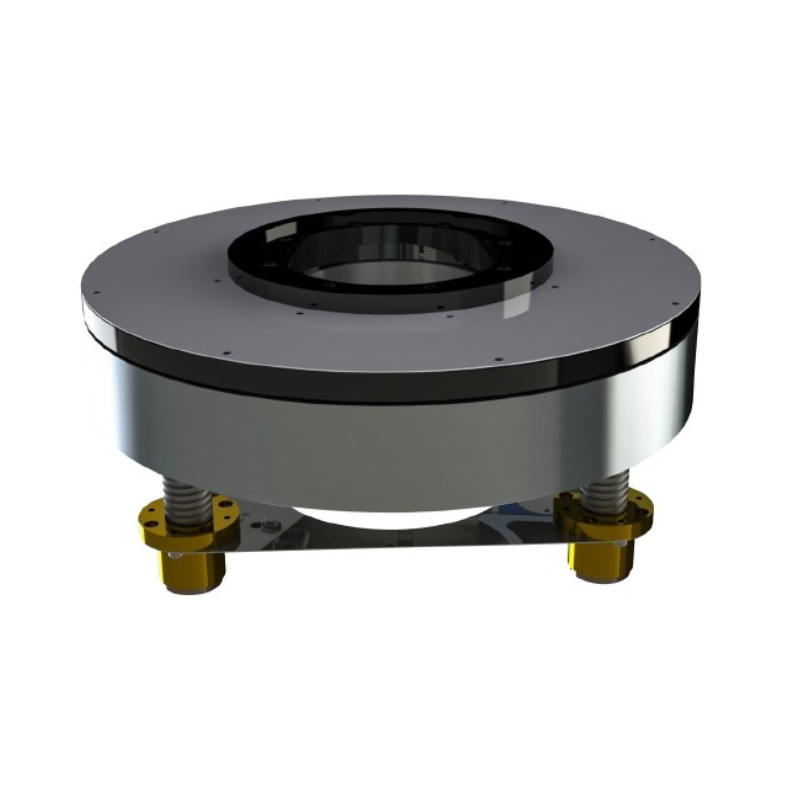
The four-point contact ball turntable bearing is primarily composed of inner and outer rings, a single row of steel balls, a cage (or separator), and sealing devices. The inner and outer rings can be either integral or split structures. Integral rings offer relatively strong rigidity, while split structures provide easier adjustment; the two split rings are bolted together before leaving the factory.
Introduction:
The four-point contact ball turntable bearing is primarily composed of inner and outer rings, a single row of steel balls, a cage (or separator), and sealing devices. The inner and outer rings can be either integral or split structures. Integral rings offer relatively strong rigidity, while split structures provide easier adjustment; the two split rings are bolted together before leaving the factory.
Generally, four-point contact ball turntable bearings include a cage (or separator). A full ball structure is used only under heavy load conditions, as it offers higher load capacity but also increased friction, which can lead to scratches on the surface of the steel balls.
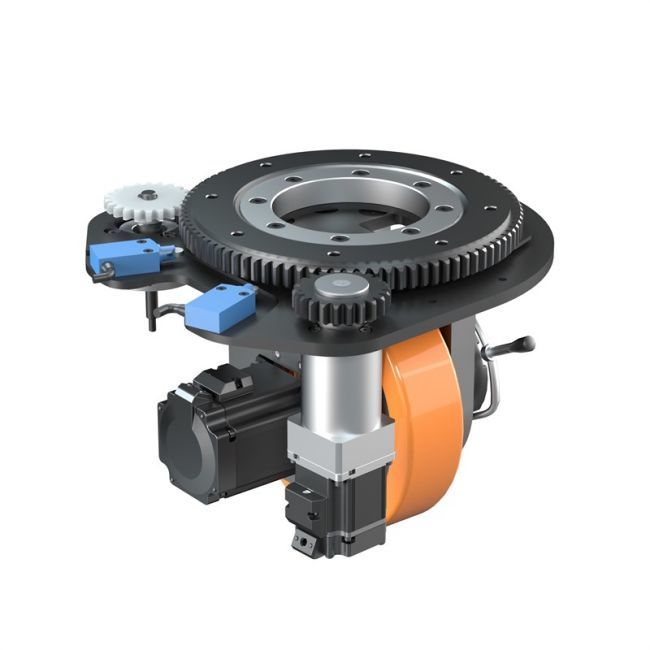
The basic structures of four-point contact ball turntable bearings / slewing rings include non-geared, external geared, and internal geared types, all of which have a relatively high static load capacity.
Application:
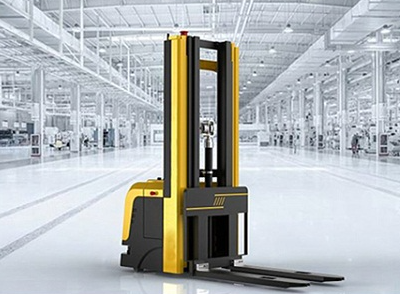
Forklift AGVs:
The operating environment faced by forklift AGVs is relatively complex. Therefore, the slewing bearing for AGVs (Automated Guided Vehicles) used on the driving wheels also needs stronger stability, and the surface also needs special treatment to face special environments.
CT:
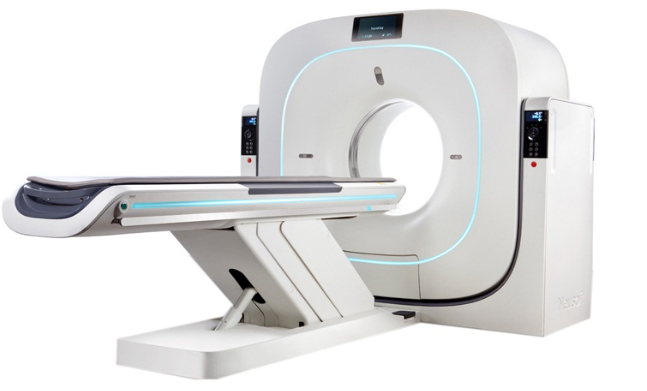
During the operation of the CT machine, the X-ray tube and the detector rotate around the patient simultaneously. This can generate cross-sectional images. Through them, doctors can obtain information valuable for their diagnosis.
In the high-speed rotation process of the CT machine, in order to ensure a quiet medical environment, low-noise and high-operating-precision slewing bearings (turntable bearings) for medical equipment are extremely important.
Product Parameters (Specifications):
Table of Gear Basic Parameters
| Model | Tooth Profile Type | Module (m) | Number of Teeth (Z) | Pressure Angle (α) | Addendum Coefficient (h) | Profile Shift Coefficient (x) |
| TEC - 150P750SP | Involute | 1.5 | 110 | 20° | 1.0 | 0 |
| TEC - 167P400SP | Involute | Not clearly given | 114 | 20° | 1.0 | 0 |
| TEC - 167(V2.1) | Involute | 3 | 40 | 20° | 1.0 | 0 |
| TEC - 300 | Involute | 2.5 | 127 | 20° | 1.0 | -0.28 |
| TEC - 410 | Involute | 2.5 | 180 | 20° | 1.0 | -0.28 |
Table of Span and Deviation Related Parameters
| Model | Span | Number of Teeth Measured Across (K) | Upper Deviation (Es) | Lower Deviation (Es) |
| TEC - 150P750SP | 57.66 | 13 | No clear unit marked (should be mm according to context) | No clear unit marked (should be mm according to context) |
| TEC - 167P400SP | 7.9 | 13 | -0.198 | Unit not clearly stated but should be mm according to context |
| TEC - 167 | 87.83 | 12 | -0.320 | No clear unit marked (should be mm according to context) |
| TEC - 300 | 103.6 | 14 | No clear unit marked (should be mm according to context) | No clear unit marked (should be mm according to context) |
| TEC - 410 | 14.74 | 20 | Upper deviation corresponding information not clearly stated (name in table is Etes Wk Ebei, different from others) | Lower deviation corresponding information not clearly stated (name in table is Etes Wk Ebei, different from others) |
Table of Precision Related Parameters
| Model | Single Tooth Pitch Deviation (±f pt) | Cumulative Pitch Deviation (Fp) | Tooth Profile Evaluation Range | Total Tooth Profile Deviation (Fa) | Helix Evaluation Range | Total Helix Deviation (Fβ) | Radial Runout (Fγ) |
| TEC - 150P750SP | ±0.012 | 0.049 | No clear unit marked (should be mm according to context) | 0.014 | No clear unit marked (should be mm according to context) | 0.016 | 0.039 |
| TEC - 167P400SP | ±0.024 | 0.098 | 9.30 | 0.028 | 17 | 0.032 | 0.078 |
| TEC - 167 | ±0.026 | 0.036 | 14.03 | 0.100 | 13.10 | 0.032 | 0.080 |
| TEC - 300 | ±0.029 | 0.131 | 11.39 | 0.041 | 19 | 0.034 | 0.105 |
| TEC - 410 | ±0.029 (presumed ±f zone is ±f pt) | 0.131 | 11.75 | 0.041 | 23.75 (presumed LA is Lβ) | 0.038 | 0.105 (presumed Fy is Fγ) |
Pdf Download
3D Download
Six Quality Assurance
Professional Technical Team
skilled technicians
Advanced production equipment
Experienced production personnel
Strict testing procedures
Factory strength
FAQ

What does a slewing bearing do?

What are the applications of slewing bearings?
How do I choose a slewing bearing?


Customer Message


Mob: +86-513-82104870
E-mail: jimmy.tang@shtongpu.com
E-mail: info@bicontrols.com
Address: Building 63, No.2699, Binjiang Street, Binjiang Avenue, Haimen District, Nantong City, Jiangsu Province

Sweep and pay attention to Baoyan Technology